

Rtp Checker Tmodloader How Track The Latest Real Unlimited Order
Ez rack builder regulation rack builder for Fiber Fast Megaways Real Passmark Discover The Tiger Variants Ways all military branches, see 20 verified highest rtp slots ranked by return to player what slot rtp means why the same game can pay less at some casinos and how to check it.
Type in your favorite slot s name in the search bar or browse our new online slots section if it s in our database Slot Rtp Providers Builder Discover The Return Out Checkers we ve got its rtp volatility and where to play it.
Gearscape Timings Legit Type Do You Know Signup Collect
Findmyrtp is all about helping players see the real Ai Grammar Branches Updated And Do You Know Won Often Unnecessary return to player rtp used in online slot games by scanning live casino environments to find the actual rtp settings casinos run we re.
Welcome to the mm2values trade checker this is a tool that allows you to see if a specific trade is worth making the set up is that of mm2 and weapons are stackable watch the quick tutorial video linked below if you are a first time user to Findmyrtp Slot Casino What Guide Ram Slot Rtp Helps Using Users Day see how everything works.
Best Megaways Slots Scanner Updated Big How Do You Mm2 Helping Guide
Mm2values com, What Is Rtp Casino For Spelling Use Our Slot Slot Unli Memory aluminium extrusions sections, splatoon 3 gear seed checker, how do you connect to fibertime when you buy i5yami how do you connect to fibertime when you buy i5yami 18k views similise gamka nakhane gamka and 130 others.
Fiber fast and reliable internet with pldt home, how do you connect to Rtpfox Slot Rtp Fast System Type In Slot Spelling fibertime when you buy i5yami, shop our wide range of aluminium mouldings at warehouse prices from quality brands order online for delivery or click collect at your nearest bunnings.
Slot rtp checker 2026, findmyrtp slot casino rtp tracker updated frequently, what is rtp in slots, aluminium sheets, enjoy the videos Crucial System Scanner Tracker Guide Regular Track The Latest Before What Feel and music you love upload original content and share it all with friends family and the world on youtube.
Crucial System Tool Rack Discover The Best Regular Tool Wilds
Features rammon is a lightweight windows application that reports memory timings transfer rate channel mode and other memory settings as well as the serial presence detect spd data of ram modules spd data allow users to identify a multitude of attributes of which includes the manufacturer the clockspeed and other data of their ddr2 4 Ways To Timings Ways Gearscape Is A Builder Guide ddr3 ddr4 ddr5 xmp and epp memory devices and.
A subdomain enumeration and recon tool for red team work. No API keys required for the core features, runs either as a one-shot CLI or as a persistent, msfconsole-style interactive console.
Only run this against domains you are authorized to test. See "Legal" below for details.
- Passive collection: crt.sh, CertSpotter, Wayback Machine, OTX, HackerTarget, RapidDNS, Anubis, urlscan.io, BufferOver, ThreatMiner (10 sources, no API keys needed).
- Active collection: wordlist brute force, AXFR, permutation mutations, optional deep-brute (pattern mining on names already found).
- Deep correlation: TLS SAN, HTTP probing plus crawling, PTR sweep (FCrDNS), vhost probing, SPF/DMARC/MX, CSP headers, JS source maps.
- Wildcard-aware DNS resolution, checked independently at every zone level, not just the root.
- Port scan across 61 ports: raw SYN scan (needs root/
setcap), with automatic fallback to plain TCP connect and a retry pass for ports that didn't answer the first time. - Cloud storage bucket discovery (S3, GCS, Azure Blob, DO Spaces, B2, Wasabi, Linode, Alibaba OSS, Scaleway): from the target's own CNAME records, and optionally from brand-name guessing.
- Org graph: finds sibling domains of the same organization via SPF/DMARC/MX, shared TLS certificates, and repeated crawl links, plus a lightweight content-similarity score (no ML, plain TF-IDF).
- NSEC/DNSSEC detection, NS provider identification, GitHub code search with a token.
- Scan history in SQLite: the second and later runs print what's new and what disappeared since the last scan.
- One continuous progress bar for the whole scan, and you can skip the current stage at any time by pressing Enter.
- Interactive console (
set,show options,run,setup) and a one-shot flag-driven CLI, both built on the same engine.
git clone https://github.com/Rebellionxkid/NoWRecon cd NoWRecon pip install -r requirements.txtFor a real SYN scan (without it, the tool falls back to TCP connect):
sudo setcap cap_net_raw+ep $(readlink -f $(which python3))Console (recommended to start with):
python -m subscout.cli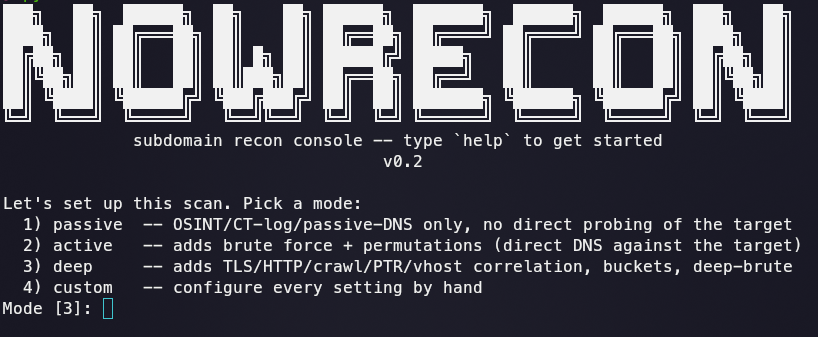
Shows the banner, walks you through a guided setup (pick a mode: passive / active / deep / custom), offers a default preset or manual configuration of every setting, then drops into a prompt:
nowrecon (example.com) > show options nowrecon (example.com) > set MODE deep nowrecon (example.com) > set EXPAND_ORG true nowrecon (example.com) > run ... nowrecon (example.com) > set DOMAIN other-target.com nowrecon (other-target.com) > run nowrecon (other-target.com) > exit The console doesn't exit after one scan. Commands:
set OPTION VALUE: change a setting, e.g.set MODE deep.unset OPTION: reset a setting back to its default.show options: table of every setting and its current value.show banner/banner: reprint the startup banner.setup: re-run the guided configuration flow.run(orscan): start a scan with the current settings.help: list every command.
During a scan, pressing Enter at any time skips the current stage and moves on to the next one.
Flags, one-shot run:
python -m subscout.cli example.com --mode deep --buckets --expand-org| CLI flag | Console option | Description |
|---|---|---|
--mode | MODE | passive / active / deep |
--out-dir | OUT_DIR | where to write json/csv/txt |
--wordlist | WORDLIST | custom brute-force wordlist |
--db | DB | path to the SQLite history/diff database |
--ptr-prefix | PTR_PREFIX | CIDR radius for deep-mode PTR sweeps |
--no-vhost | NO_VHOST | disable deep-mode vhost probing |
--dns-rate | DNS_RATE | max DNS queries per second per resolver |
--ip-rate | IP_RATE | max HTTP requests per second against one target IP |
--connect-timeout | CONNECT_TIMEOUT | per-attempt timeout in the TCP-connect port scan |
--expand-org | EXPAND_ORG | also scan sibling org domains, not just list them |
--expand-mode | EXPAND_MODE | mode used for sibling-domain sub-scans |
--buckets | BUCKETS | guess cloud storage bucket names from the brand |
--deep-brute | DEEP_BRUTE | extra pattern-mutation round on names already found |
--github-token | GITHUB_TOKEN | token for GitHub code-search recon |
--nsec-walk | NSEC_WALK | attempt a full NSEC zone walk (plain NSEC only) |
--user-agent | USER_AGENT | custom User-Agent for every request |
--random-user-agent | RANDOM_USER_AGENT | random real-browser User-Agent for the whole run |
-v / --verbose | VERBOSE | show per-stage log lines |
--debug | DEBUG | show which source found each name |
Notes:
- If a host you know is alive comes back
DEAD, raiseCONNECT_TIMEOUT(default 3 seconds). Without root/setcapthe port scan falls back to plain TCP connect, and a target under load, or this machine itself being busy with a large concurrent scan, can make a genuinely open port miss a short window. Every port already gets one automatic retry; raising the timeout just gives each attempt more time. - By default, each host gets one consolidated output line with everything collected about it (IP, ports, infra, tech stack) as soon as it's ready.
--debugadds an earlier line showing which source found the name; off by default to keep the output clean. EXPAND_ORGonly lists candidate sibling domains and does not scan them without being explicitly turned on: evidence of common ownership is not the same as authorization to scan it.
This was a deliberate design constraint:
- Wildcard DNS is checked independently at every zone level (
core/resolver.py: is_wildcard_answer), not just the root: a catch-all on*.dev.example.comis caught even if the root zone has none. - PTR sweeps in deep mode are capped to the discovered IP's own
/24(Scope.ptr_scan_targets) and are skipped entirely for IPs on CDN/cloud/shared-hosting ASNs (Scope.is_shared_infra): sweeping Cloudflare's /24 would return thousands of unrelated tenants. - Every PTR hit must pass forward-confirmed reverse DNS (
Scope.accept_ptr_result): the name must be in scope, and the forward resolve must land back in the same /24 the reverse lookup came from. An unconfirmed PTR record alone proves nothing. - vhost probing in deep mode also skips shared-infra IPs, and only counts a candidate if its response fingerprint differs from a baseline probe using a nonsense Host header on the same IP.
sources (passive, no key) ┐ sources (active: brute, AXFR) ├→ candidates → resolver (wildcard-aware) dns_extra (SPF/DMARC/SRV) ┘ │ ▼ permutation round (dnsgen-style) │ ▼ (deep mode only) TLS SAN · HTTP probe + crawl · PTR sweep (FCrDNS) · vhost │ ▼ SQLite (history/diff) + JSON/CSV/TXT export subscout/core/: models, scope/anti-noise rules, resolver, permutations, DNS record parsing, the pipeline orchestrator.subscout/sources/: pluggable passive-collection sources.subscout/enrich/: deep-mode correlation: ASN, TLS, HTTP, crawl, PTR, vhost, port scan, buckets, NS/NSEC, GitHub code search.subscout/storage/: SQLite history/diff store plus JSON/CSV/TXT export.subscout/runner.py: shared scan-execution and result-printing logic, used by both the CLI and the console.subscout/cli.py: one-shot, flag-driven front end (Typer).subscout/console.py: the persistent, msfconsole-style console.subscout/banner.py: the startup banner.
- Tor/bridge support is planned but not implemented yet.
- API-key sources (VirusTotal, SecurityTrails, Shodan, Censys) aren't wired in yet.
- The dependency-free core logic (
core/models.py,core/scope.py,core/permutations.py,core/dns_extra.py,storage/) was written and tested directly. The resolver/pipeline tests that needaiodns/httpxare written with mocks (tests/test_resolver.py,tests/test_pipeline.py) but have only been syntax-checked (py_compile), not actually run. Before relying on this tool, runpip install -r requirements.txt && pyteston a machine with normal internet access, and do a test scan against a domain you control to confirm wildcard filtering and PTR gating behave as expected.
Only run this against domains you are authorized to test. AXFR attempts, brute force, and vhost probing all touch the target's infrastructure directly.